Why Current Automation Strategies Fall Short of True Agility
For too long, enterprise automation has been a game of whack-a-mole: addressing symptoms with point solutions rather than systemic inefficiencies. Despite significant investment, a recent Deloitte survey indicated that only 13% of organizations have scaled their intelligent automation initiatives beyond initial pilots. This isn't for lack of trying; it's often due to fragmented systems, reactive approaches, and a fundamental misunderstanding of what 'autonomy' truly means in a business context. Traditional Robotic Process Automation (RPA) excels at automating repetitive, rule-based tasks, but it struggles with dynamic decision-making, exception handling, and proactive problem-solving. This limits true operational agility and leaves significant OpEx reduction opportunities on the table.
The challenge isn't merely to automate tasks, but to build adaptive systems that anticipate needs, optimize workflows autonomously, and free up human capital for strategic initiatives. Without an overarching orchestration layer, disparate AI models and automation scripts become isolated islands, creating new silos rather than bridging existing ones. The future demands more than just automation; it requires intelligent, self-optimizing agency.
Ready to assess your automation readiness? Download our Autonomous Agent Readiness Checklist to pinpoint your organization's gaps and opportunities.
The Imperative: Orchestrating Autonomous AI for Predictive Operations
The next frontier in business automation isn't about more bots; it's about smarter, interconnected agents that operate with true autonomy and foresight. Gartner projects that by 2026, over 80% of enterprises will have adopted some form of autonomous agents, fundamentally shifting operational paradigms and unlocking up to 30-45% in operational agility. This isn't just a trend; it's a strategic imperative for competitive advantage and sustained growth. Predictive operations, powered by orchestrated autonomous AI, allow businesses to move from reactive problem-solving to proactive optimization, often before issues even arise. For a deeper dive into these opportunities, refer to our insights on Proactive OpEx Reduction: Achieve 30-45% Operational Agility with n8n Autonomous Agents by 2026.
Beyond RPA: The Shift to Self-Optimizing Workflows
Unlike conventional automation, autonomous agents are designed with agency. They don't just follow pre-programmed rules; they observe, analyze, learn, and make informed decisions to achieve defined objectives. This involves a complex interplay of large language models (LLMs), specialized AI models, data analytics, and decision-making frameworks. These agents can manage entire processes end-to-end, from customer support escalation to supply chain optimization, continually adapting and refining their strategies based on real-time data and outcomes. This shift redefines efficiency, moving from mere task execution to intelligent, dynamic process management.
n8n as the Orchestration Layer for Complex Agent Networks
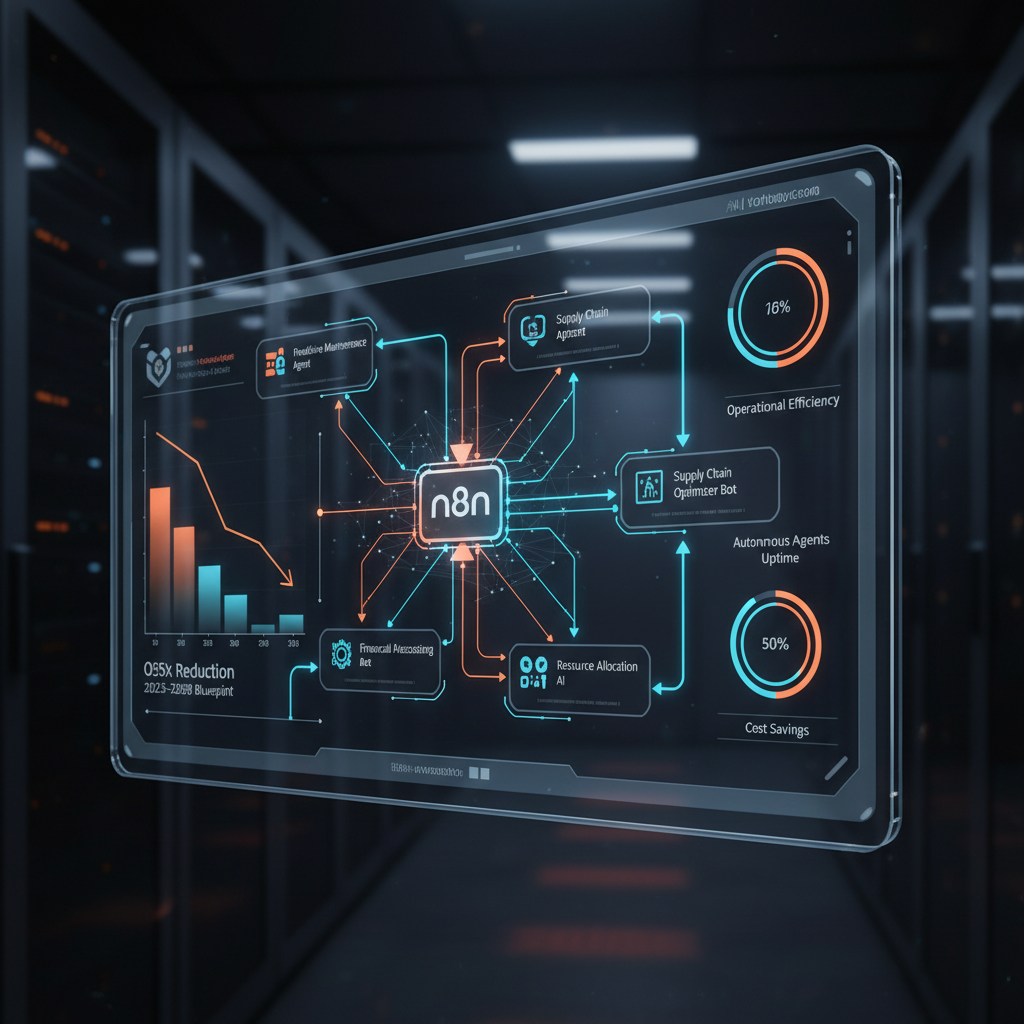
At NODYT, we recognize that building individual agents is only half the battle. The true power emerges from their orchestrated synergy. This is where n8n, our platform of choice, becomes indispensable. n8n acts as the central nervous system, enabling seamless communication, data flow, and workflow management between diverse autonomous agents, bespoke Python scripts, and existing enterprise systems. It provides the visual interface and robust backend to:
- Connect Anything: Integrate AI models (OpenAI, custom LLMs), CRMs, ERPs, databases, and APIs.
- Define Workflows: Design intricate multi-agent processes, setting triggers, conditions, and sequential or parallel execution.
- Monitor & Manage: Gain real-time visibility into agent performance, identify bottlenecks, and facilitate debugging.
- Automate Feedback Loops: Enable agents to learn from outcomes, adjusting parameters and strategies for continuous improvement.
This orchestration capability is critical for achieving the 20-40% OpEx reduction we discuss in Autonomous AI Agents: Redefining B2B Operations for 20-40% OpEx Reduction by 2026.
Ready to operationalize autonomous agents? Schedule a Strategy Session with a NODYT Expert to design your orchestration framework.
Blueprint for Implementation: Building Your Autonomous Agent Ecosystem
Implementing an autonomous agent ecosystem requires a structured, strategic approach, not a haphazard integration of tools. Our experience at NODYT shows that a structured implementation approach reduces time-to-value by 40% and increases successful agent deployment rates by 50% compared to ad-hoc methods. This blueprint leverages our expertise in n8n and Python to ensure scalable, secure, and impactful deployments.
Phase 1: Identifying High-Leverage Operational Bottlenecks
The first step is data-driven. We work with CTOs and VPs of Ops to conduct a thorough analysis of existing operational processes. This involves:
- Mapping current workflows to pinpoint areas of manual intervention, high error rates, and significant OpEx.
- Quantifying potential savings and strategic gains for each identified bottleneck.
- Prioritizing use cases based on impact, feasibility, and alignment with enterprise objectives.
This ensures that autonomous agent deployment targets areas where they can deliver the most tangible ROI, moving beyond theoretical benefits to measurable financial and operational improvements.
Phase 2: Designing Agent Architecture & Communication Protocols
Once high-leverage areas are identified, NODYT designs the specific agent architecture. This involves:
- Agent Definition: Clearly defining each agent's role, responsibilities, capabilities, and decision-making parameters.
- Inter-Agent Communication: Establishing robust, secure communication protocols and data exchange formats facilitated by n8n.
- Integration Strategy: Planning seamless integration with existing enterprise systems (CRMs, ERPs, data lakes) using n8n's extensive connector library and custom Python nodes.
- Security & Governance: Implementing strong security measures and governance frameworks to ensure compliance and mitigate risks.
For a comprehensive guide on transforming your enterprise, consult our Strategic AI Automation: Blueprint for Enterprise Transformation.
Phase 3: Iterative Deployment, Monitoring, and Self-Correction
Deployment is an iterative process, focusing on agility and continuous improvement. We don't just 'launch and leave'.
- Pilot & Validate: Deploy agents in controlled environments, rigorously testing their performance against defined KPIs.
- Real-time Monitoring: Utilize n8n's logging and analytics capabilities to monitor agent activity, detect anomalies, and track performance metrics.
- Feedback Loops: Implement automated and human-in-the-loop feedback mechanisms. Agents learn from success and failure, refining their logic and decision-making processes over time.
- Scalable Expansion: Gradually expand agent deployment across the organization, leveraging insights gained from initial pilots to optimize future rollouts.
This iterative approach minimizes risk, maximizes learning, and ensures that your autonomous agent ecosystem evolves with your business needs.
Tangible ROI: Realizing Strategic Agility and OpEx Gains
The promise of autonomous AI is not just conceptual; it's about demonstrable, measurable results. A recent NODYT client in logistics, implementing an n8n-orchestrated autonomous agent system for supply chain optimization, achieved a 28% reduction in manual data reconciliation costs and accelerated decision-making by 42% within 9 months. This translates directly to millions saved and a significant boost in competitive responsiveness.
By leveraging n8n to orchestrate autonomous AI agents, businesses can move beyond siloed automation to a truly integrated, intelligent operational framework. This delivers:
- Predictive OpEx Reduction: Anticipate and mitigate operational costs before they impact the bottom line.
- Unprecedented Agility: Adapt rapidly to market changes, supply chain disruptions, or new business opportunities.
- Enhanced Decision-Making: Empower operations with real-time, data-driven insights.
- Strategic Workforce Reallocation: Free human talent from mundane tasks to focus on innovation and high-value strategic initiatives.
The future of AI automation isn't a distant concept; it's a present-day imperative for those ready to embrace orchestration. The competitive landscape will not wait for laggards.
Ready to quantify your potential savings and strategic impact? Request Your Custom OpEx Reduction Audit today.